Pilates · The principles
Pilates
How Caroline teaches, in four parts. Read them in order — each one builds on the last.
Relaxation and Concentration
Pilates is a mental and physical programme aiming to train both the body and mind. We must therefore concentrate on positioning, alignment and the quality of movement until these responses become automatic.
It is important in Pilates to be completely relaxed in order to get the best out of each exercise. We must try to leave any stresses we may have encountered behind, and not bring them to the class. Concentration and relaxation will aid learning to the body and mind.
Breathing
Breathing is a major component of Pilates. We want to encourage the use of the lower parts of our lungs, we call this lateral breathing. We should breath by expanding the ribcage outwards and to the back of the ribcage.
It is difficult at first to coordinate our breathing and concentrate on the exercises, but as a general rule we:
- Breathe in to prepare for movement
- Breathe out to centre our abdominals during movement
- Breathe in to recover while holding the centre
Try not to get too caught up in the breath, it will come, it is more important to continuously breathe – Breath helps the body learn!
Stability
Pelvic Stability and Deep Abdominal Engagement
To find our pelvic neutral try the following:
- Lie on your back with the knees bent and feet slightly apart
- Imagine the pelvis has a compass on it; the navel is north, pubic bone south – east and west each side.
- Tilt the pelvis to north as far as possible so the back flattens, then gently tip the pelvis as far south as comfortable so you get a small arch in the lower back. Neutral position is between these two extremes.
Moving on, bringing legs together and pressing the upper pelvis and lower spine into the mat, while drawing the navel down towards the spine – connecting the lower back to the mat. This is the starting possiton for supine (laying on your back) exercises.
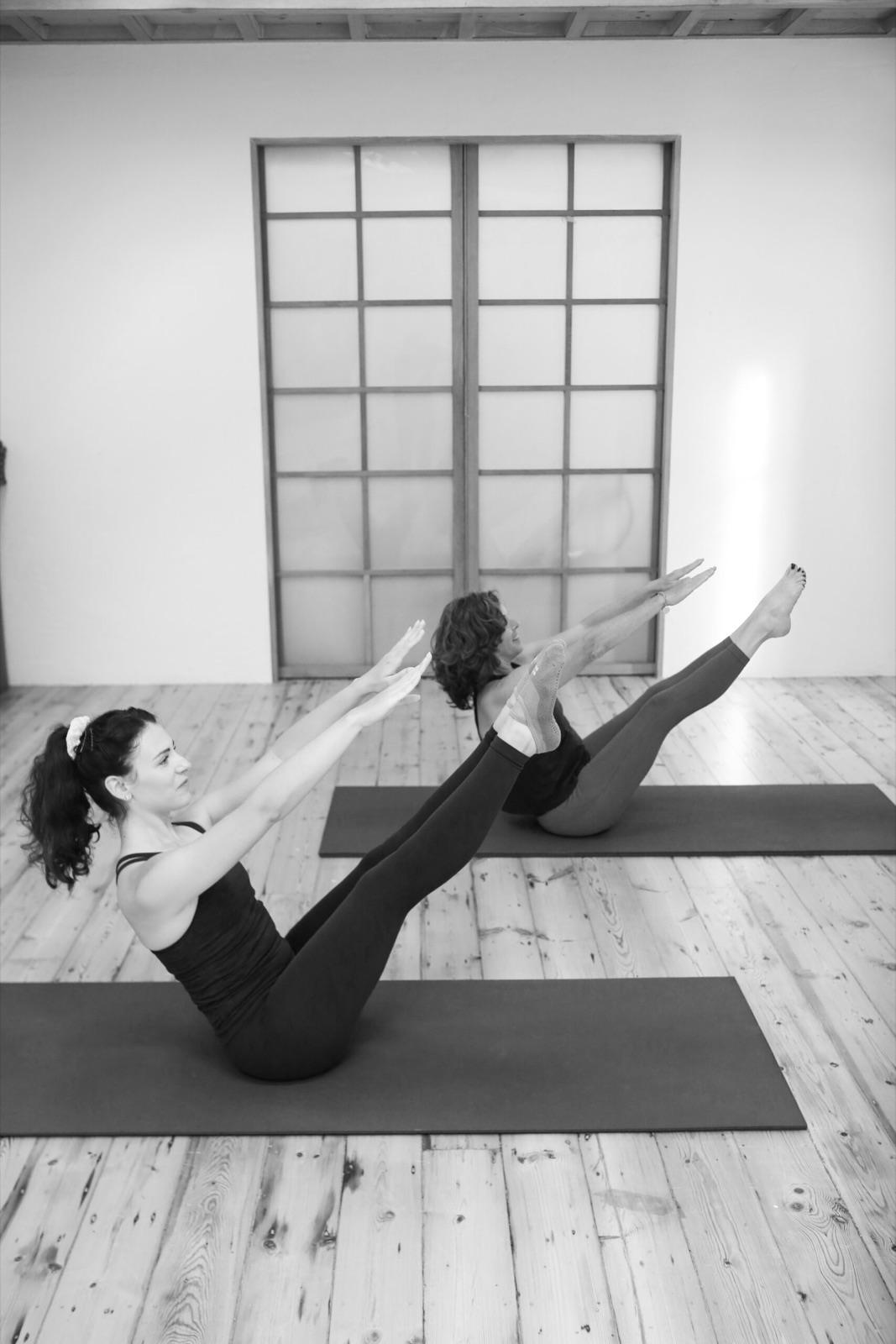
To engage our lower abdominals as we breathe out we must try to draw up the muscles of our pelvic floor and hollow the lower abdominals in toward the spine, like an internal zip. By contracting these muscles we create a “girdle of strength” forming a natural corset to protect our lower backs.
To practise contracting lower abdominals:
- Gently breathe in and out as described earlier
- As you breathe out draw up the muscles of the pelvis and then zip up, to hollow the lower abdominals back towards the spine. Keeping the pelvis tilted backwards, with the lower spine pressed into the floor.
- Breathe in and release
- Do not hold your breath
Ribcage Placement
Our abdominal wall attaches to our lower ribs. Using our abdominals will help us to stabilise the ribs and keep our thoracic spine (middle back) in good alignment. During inhalation we should have the feeling of breathing into the back and sides of the ribs. During exhalation we should feel as though the ribcage softens drops towards the hips.
Shoulderblade Positioning and Stabilisation
Most of us have a tendency to over work our upper trapezius muscles, (the muscles at the top of the shoulders.). We must try to relax these muscles at all times and maintain our shoulder blades stabilised against our ribcage.
Practice the feeling of gently pulling the shoulder blades down and back towards the spine.
Head and Neck Positioning
The head and neck must stay in correct alignment throughout our exercise. We should feel as though the skull is balanced directly over the shoulders, and as though a string is gently pulling the head up and away from the shoulders, giving us a feeling of length at the back of the neck.
To practise using our deep neck flexors:
- Lie on the floor with the knees bend and fleet slightly apart
- Gently tuck the chin in towards the chest, (while leaving a space between the chest and chin) sliding the head along the floor. You may need a small folded towel under the head if you feel the neck is falling back too far
Co-ordination and Flowing Movement
It is not easy to combine all of the above components, but as we practice it will become more automatic. By repeating these positions and progressing through exercises we will start to change the way we move and correct our bad habits of day-to-day life.
All the movements in Pilates should be controlled and flowing. They should be performed slowly, with precision and from a strong centre, making it harder to cheat.